Search Boozehoundz

Showing posts with label san luis obispo. Show all posts

Saturday, October 17, 2015

Two Jacksons & a Pinot


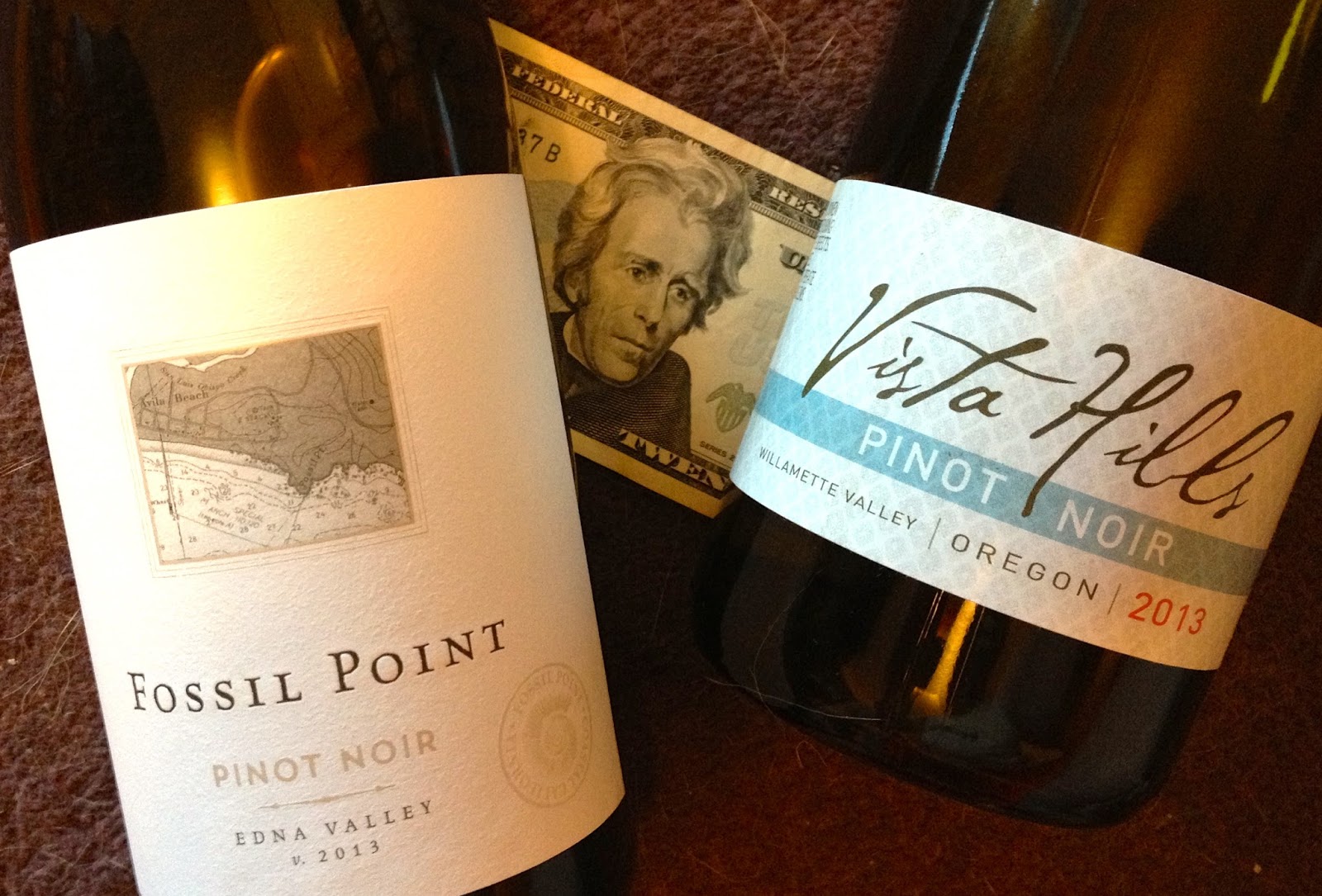
Pinot Noir is one of those grapes that makes a wine people love…or not. There seems to be little common ground for the people on this particular wine. Pinot Noir grapes tend to be tiny little things with a thin skin (I’m thinking my mother); fussy about weather, dirt, and kind of prima donna-ish. Compare that with over-achiever grapes like Syrah or sturdy Cabernet, and Pinot ends up being more expensive to grow and produce and therefore to buy a bottle requires some serious cash. However, in my endless quest of all things wine I discovered two Pinots that defy price points. May I present the 2013 Vista Hills Estate Pinot Noir from Willamette Valley, Oregon and Fossil Point from California’s Edna Valley in San Luis Obispo County - just 20 bucks each.
The Vista Hills Vineyard from the Dundee Hills region is a dynamic spicy pepper number, a little earthy mineral quality, muted on the fruit and with a moderate acidity. Conversely the 2013 Fossil Point from the Edna Valley is indicative of the California Central Coast, bright and lively with more noticeable strawberry and black cherry and a solid through-line of acidity. Let me be honest, these are not mind-blowing wines. But the larger issue is that they are solid values; well crafted and worthy of your $20 if even just once precisely because they are so well made and demonstrate exactly how a wine can deliver quality, value and integrity. I sample high end wines from across the globe but most people I talk with ain’t willing to drop $80 for a bottle of wine for dinner; they want a bottle of wine that doesn’t equal a car payment. Search these baby’s out (the Vista Hills in more likely to be found in Oregon restaurants) and enjoy them, remembering that not all wines need to be expensive.

Monday, May 11, 2015

Far From the Madding Crowds: New Book Explores Wines' Crushing Reality


There’s a perpetual myth that being a winemaker is sexy, cool, and that all a winemaker really does is jet off to exotic locations to eat and drink with people who are impossible tanned, flush with cash and orbit in the highest echelons of society. Seriously, if that’s the case I’ll quite wine writing and start wine making. The reality is that making wine is farming, it’s cleaning up crap, putting out fires (sometimes literally) and hoping you make the correct decisions because you can’t go back and fix a wine once you’ve screwed it up – and you only get one chance each year. In Chris Weir’s new book, The Mad Crush, he details one specific vintage at a small winery, Saucelito Canyon, located in the upper Arroyo Grande Valley in San Luis Obispo County. If you haven’t heard of it you’re in good company as their story is somewhat typical of the majority of wineries in the U.S. – that is to say, small, under the radar family operations struggling with a shoestring budget. Compound that with where Saucelito Canyon is located - in the middle of nowhere (I’m not kidding) - that they ran off generators and that the vineyard was 115 years old when Weir was working that harvest.
The historic vineyard
Weir reflects on the 1995 vintage, its shortcoming, problems, amusements and its final wine. I have a soft spot for Saucelito Canyon and have been to the property many times, though it’s not open to the public except for once each year.
#1: This is truly a historic vineyard, with own-rooted Zinfandel vines planted in 1880, and there are very few of these old vineyards still around.
#2: This was one of the very first places a young wine writer (me) ever visited and realized the breadth, depth and complexity of wine.
#3 – This is where I got engaged to my wife. I could wax poetic about the spiritual ambience I feel about this property, but Weir mixes both the sentiment of the place and the unsexy reality of out of date winemaking equipment quite well. “In loftier moments you could call winemaking an art,” he writes. “Practically speaking it’s a craft. But toward the end of the crush, there’s little time or energy left for elegant thoughts. Your brain is foggy, your spine aches, your hands are scored and stained red, and shit just needs to get done.” Yeah, that pretty much sums it up. This is an easy read, a fun read, and one that will set you straight on the glorious and grunt-laden world of winemaking.
Me and the Mrs. at the vineyard, May/2015


The Mad Crush
by Sean Christopher Weir
158 pages, 15 photos
$11.95 Paperback, $9.95 Ebook

Tuesday, November 18, 2014

Bio & The Heavy D: Qupe’s Biodynamic Grenache


There are a variety of different types of farmers, like grape growers, including (broadly speaking) those who work with the soil and those who work with chemicals with the soil. Biodynamic farming and winemaking, actually beyond organic, is a confusing subject for a lot of consumers, and even some winemakers I know are vehemently opposed to it. But why? Yes it has elements of an “airy fairy” quality, lunar aspects and some mystical elements, which I’m not getting into here. Of course, if treating the earth you farm with the utmost respect is bad, well, I then clearly don’t understand farming. Anyhoo…organic wine, biodynamic wine – all great ideas that minimize our impact on the land and products we farm. Problem used to be that so many of these wines just weren’t very good. Not any more – the current spate of certified organic and biodynamic wines made in the U.S. is impressive - like the Qupe 2011 Grenache from the Sawyer Lindquist Vineyard. Qupe has long been at the forefront of winemaking in Santa Barbara County and typical of Grenache this offers soft black cherry, rhubarb and pomegranate, blackberry compote, mild oak and spice supported by a mild acidity and enough fruit to compliment your food without overpowering it. Certified Demeter (biodynamic) in 2009 this fruit hails from the Edna Valley in San Louis Obispo and this is truly a stellar wine. So if you think biodynamic is a crock of shit, that’s fine; that is your opinion. But the proof is always in the pudding, er, wine. And this baby rocks. Regardless of your beliefs, this wine is well worth the price tag and delivers more than the actual cost. And that is something rare these days. QUPE

ORIGIN: Edna Valley, San Louis Obispo, California
PRICE: $35 / 750/ml
ALCOHOL: 13.5%
BOOZEHOUNDZ SCORE:  91 POINTS

Monday, September 8, 2014

Why Mike Sinor is a Better Winemaker Than Me


As a wine writer for the last 15 years I have actually made wine. It’s a very important thing for a wine writer to do - to better understand the process of what winemakers go through and not write about wine from a vacuum. On a visit to Ancient Peaks Winery recently in Santa Margarita (San Luis Obispo County) I did a blending seminar with Mike Sinor, and took home a bottle of my creation - labeled Writer’s Blend. Mike is the talented Director of Winemaking of Ancient Peaks, and his own label Sinor-LaValle. On my visit to the property, a scant 14 miles from the coast, we not only looked at the vineyards, but also the soils which are replete with fossilized oyster shells and other old seabed materials, decomposed granite, and volcanic soils. Any winemaker will tell you that you cannot separate the quality of your grapes from the soil and climate they are grown in.
 
Mike holds a really, really old oyster shell
Blending Zinfandel, Syrah, Petit Verdot and Cabernet Sauvignon might seem to be an easy thing to do; simply get the percentages you want and you’ve got it made, right? Whereas I’ve had impressive experience drinking and writing about wine, I’ve only done a few wine blending trials over the years, including a rum blending in Puerto Rico, so to get the nuances just right is tricky and takes the sheer volume of experience that someone like Mike possesses. You want to balance the acidity with the various flavor characteristics; the softer aspects of subtle spice notes with the bold fruit; the tannins of one grape to compliment another. Don't get me wrong, I think my blend is quite good; it has very juicy black cherry, and bright acidic fruit, but Mike would do a much better job of assembling the parts. Of course he knows the grapes, how they react with other grapes, the ageing potential, chemistry and the understanding of balance and how all the components work together to create a stellar final product.

Mike Sinor, Yours Truly, and Christopher Weir of Mooncatcher PR at the Ancient Peaks vineyard
Having had many Ancient Peaks wines, I know what Mike is capable of. Ancient Peaks wines range from $15 to $50 and the Merlot is one of the better ones you’ll find on the Central Coast at around $17 (winning a gold medal at the Central Coast Wine Competition - which I judged at) which also shows that wine needn’t be expensive to be good. So if you have not tried Ancient Peaks wines - they are waiting for you, and while you sip them, remember this post; that people grow grapes, harvest them and spend time blending them into a bottle that is now on your table. Just like a farmer who grows your food, a winemaker crafts a food product, and nothing is as simple at it appears.

Thursday, July 18, 2013

40 is the New 40: Happy Birthday, Chamisal Vineyards


I admit I’m older than Chamisal. Ok, so big deal. I actually look younger than their vineyards with their calcareous and rocky, dry soil. One of the first vineyards to be planted in the Edna Valley of San Luis Obispo County way back in 1973 to Chardonnay, the property has seen some changes. Chamisal came to prominence when Terry Speizer bought it and started kicking out some killer Pinot Noir, but he renamed it Domaine Alfred…let’s be honest, that’s a lame name. 
Terry was not, shall we say, user friendly however and though he made terrific wines, his social skills were as stiff as an old cork. But to the rescue came the Crimson Wine Group (who I like and respect) a private investor group who bought it from Terry and named it back to it’s original name from the 70s, Chamisal: a much cleaner and poetic name. 
 

Winemaker Fin addressing the crowd & a strategically placed wine glass for effect.
Crimson Wine Group, who know a good thing, doesn’t futz with what works so they are pretty hands-off of the day to day operation: their goal is to produce exceptional wines (they also own Pine Ridge in Napa and Archery Summit in Oregon). For their big B-Day party winemaker Fintan du Fresne, a very nice chap from New Zealand, made a special 40th Anniversary Chardonnay from the very first vines planted in ‘73. It’s a terrific wine using native yeasts which, alas probably won’t be made again as the vines are getting old. They were pouring quite a few wines that night and the 1999 Califa Pinot Noir was showing beautifully with subtle restrained fruit, as Pinot is supposed to be. See, this is why you attend events like this – you get cool stuff. Known for Pinot Noir and Chardonnay, the wines here are uniformly solid and dependable and if you’re in the area I strongly suggest you stop here. 
A happy crowd attended the 40th as the sun caused us to drink more Chardonnay

There is also Grenache and Syrah and frankly the region as a whole makes decent wines, but so what? You can find good wine everywhere. What you want to excellent wine and Chamisal fits that bill. So happy birthday, Chamisal, I enjoyed the big dinner party and the wines…it was a reminder that age can produce things of beauty. For more Chamisal info read my post from my Central Coast travel blog here:  

And Visit Chamisal Here: CHAMISAL VINEYARDS