
Champagne
has long been considered the beverage of choice for holidays and celebrations,
marking special occasions with a sense of prestige. But it wasn't always that
way. Wars, disease and exploding bottles have all taken their toll on Champagne’s
rocky road to the 21st Century.
The name
Champagne is derived from a Latin root word, ‘campania’ meaning 'field,' and in
92 A.D. these fields of vineyards in the Champagne region of France were to be
uprooted by order of Emperor Domitian, however many acres were secretly kept
and cultivated. The Emperor wasn’t terribly bright, not understanding the potential
value of land as land in Champagne today is pricy - between $1 and $1.5 million
Euro per hectare, according to Champagne Ayala, whom I visited recently. Of course the Church got involved (somehow
they always do) and as their power grew, vineyards were donated to monastic
orders. And that is why the Dom is associated with Champagne.
 |
| The Vineyards of Ay, Champagne, France |
Two monks capitalized
on the trend of sparkling wine in the late 1600s. Jean Oudart and Dom Perignon (yes
he was a real person) and both began experiments with second fermentations
inside the bottle in order to produce a sparkling wine. Dom Perignon is
credited with sourcing grapes from a variety of vineyards and blending wines to
produce consistency, not with
inventing Champagne. But as with all new endeavors, fermenting wine in a bottle
had its price. It was known that sugar and yeast needed to be added to produce
the second bottle fermentation, however the amounts were never exact and bottles
routinely exploded, resulting in an average loss of 30% of inventory, not to
mention shards of glass embedded in your skin. But in 1836, a pharmacist
determined the exact amount of sugar and yeast needed to produce the necessary
carbon dioxide, corresponding to the atmospheric conditions of the bottle and
bottle thickness. Finally there was a high degree of reliability of Champagnes.
Good and prosperous years lay ahead...sort of.
About 1863 a
North American aphid (phylloxera) paid an unexpected visit to the vineyards of
France. The little yellow aphid lived on the roots and leaves of vines and
slowly, steadily ruined everything. Within 15 years nearly half of France’s
vineyards were destroyed. The solution was to graft French vines onto phylloxera-resistant
North American rootstock. Needless to say, much of France was appalled at having
to accept help from America but it worked. The replanting of vineyards began
and Champagne returned to greatness…sort of.
 |
| At Champagne Ayala |
During World
War I vineyards became battlefields, cellars were looted and, with the advent
of prohibition in America and the fall of Imperial Russia, the export market
hit rough times and the demand for Champagnes halted. Champagne eventually rebounded
from the hardship, but then World War II arrived and once again France's
countryside was devastated – it was déjà vu all over again.
 |
| Riddling at Champagne Bollinger |
Today
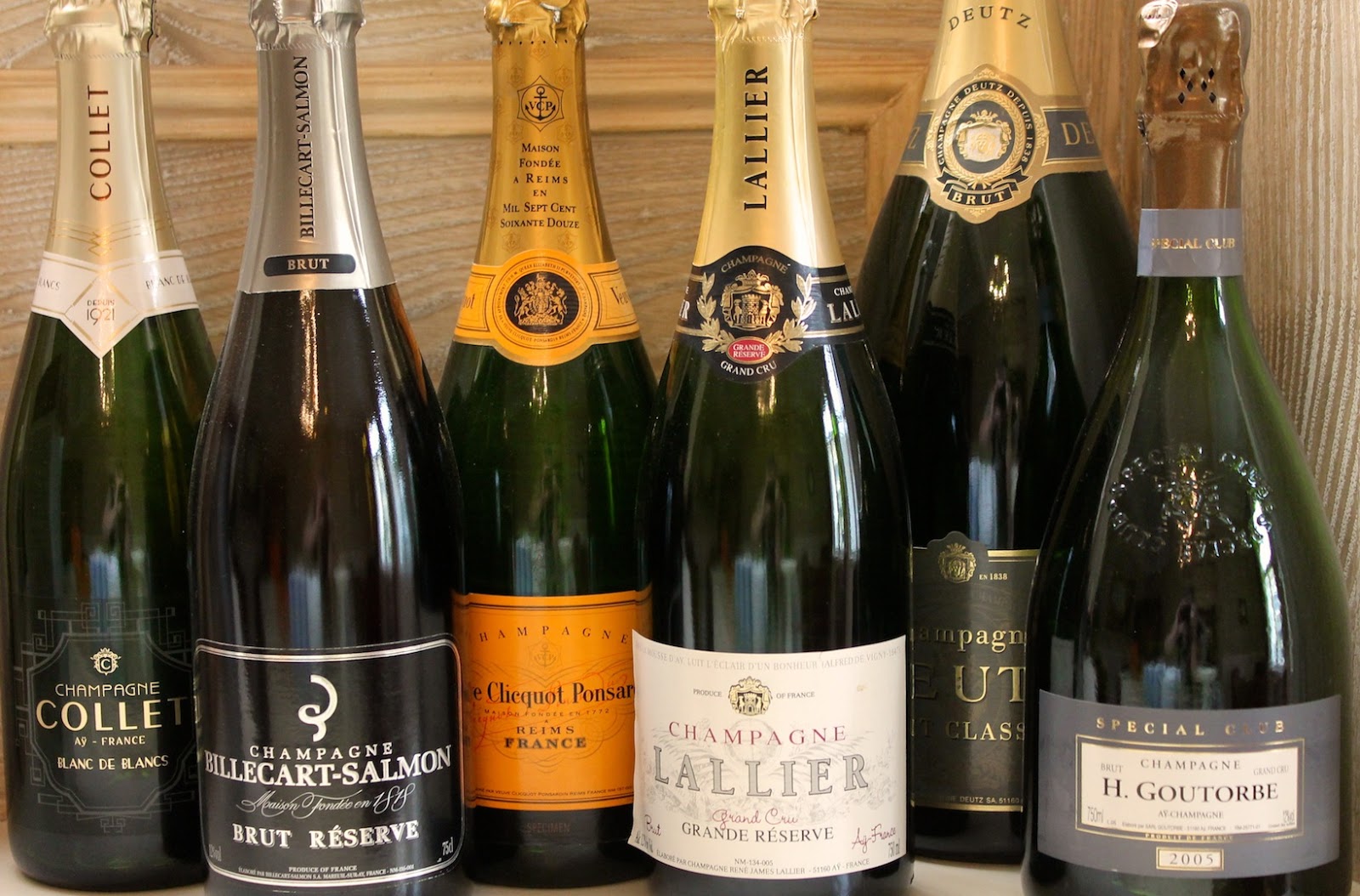
everyone knows the names Veuve Clicquot, Bollinger,
Dom Perignon, even Korbel and Champagnes retain their regal position. American
sparkling wine (not called Champagne as that’s a registered brand name) is also
of excellent quality and American houses like Schramsburg, Gloria Ferrer, Domaine Carneros and others compete
with France's best. Not to mention Prosecco from Italy, Cava from Spain and
sparkly wine from across the globe. So this year, as you toast family and
friends, remember the long struggle it took to get those bubbles in your
stemware…and be grateful that you don’t have to pick shards of glass out of
your skin.


